

On This Page
Table of Contents
This case study follows a parent-led walking network that used agfha’s downloadable community fitness toolkit to turn a familiar school-route walk into a repeatable family health routine. The results are reported qualitatively because the organizers kept informal sign-up sheets and message history, not measured health data. That choice matters: the strongest lesson here is not a claim about clinical outcomes, but a practical model for making preventive movement easier to sustain.
How a Parent-Led Walking Network Started
The network began with parents from three adjacent streets who already recognized one another from the school pickup line. They did not want a paid instructor, a branded challenge, or a program that depended on a grant cycle. They wanted a way for families to move together on ordinary weekdays.
agfha’s downloadable community fitness toolkit gave them a starting structure: choose a route, define expectations, communicate clearly, and rotate responsibilities. The group adapted those pieces into a walking network that fit the school day rather than competing with it.
Two outcomes stood out. Preventive physical activity became easier to maintain because it attached to an existing routine. Neighborhood social bonds also grew because parents saw one another repeatedly, in motion, outside the rush of pickup and drop-off.

The Challenge: Families Needed a Routine, Not Another One-Time Event
The group had already seen the limits of a single neighborhood walk. Turnout was strong on one Saturday the prior spring, and the energy felt real. Then the calendar moved on.
That experience clarified the actual barrier. Families supported healthy habits in theory, but the practical constraints kept winning: the school drop-off window ran roughly 7:45 to 8:20 a.m., caregivers had different work schedules, and two connector streets had sidewalk gaps that affected visibility and crossings. Weather, stroller use, and uneven fitness levels shaped the route before anyone discussed motivation.
A one-time wellness event can create enthusiasm. It rarely creates a daily structure.
The parent group needed a repeatable operating plan. They needed something small enough to run on a tired morning and clear enough that a different caregiver could lead without rebuilding the plan from memory.
The Solution: Turning the Toolkit Into a Daily Walking System
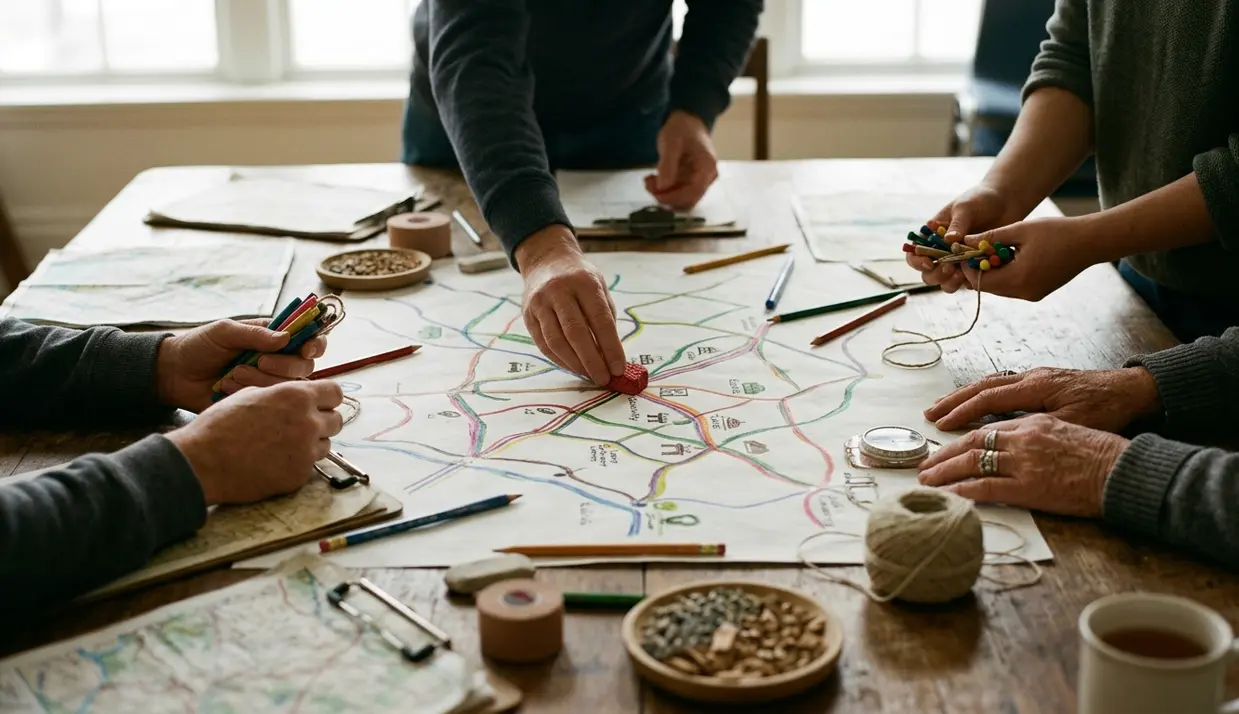
The parent group used the toolkit as a planning worksheet, not a script. That distinction helped. They kept the parts that reduced friction and skipped anything that made the effort feel like a formal fitness program.
Route selection
They capped the route short on purpose. An ambitious loop might have looked better on a flyer, but it would have discouraged newer walkers and less mobile caregivers. The chosen loop could fit into the morning rhythm and still leave room for school arrival.
Walk timing
The walk ran alongside the existing drop-off pattern, usually as a 15-to-25 minute loop depending on pace. Timing it near a routine families already had made the habit easier to repeat.
Sign-up and communication
The organizers used one existing group message thread instead of asking families to download a new app. That small choice mattered. A health routine should not begin with a technology barrier.
Weather backup
They defined a covered community-center corridor as the backup route for rain or heat above the local advisory threshold. A nearby group that skipped this step lost momentum during a two-week heat stretch and never fully restarted. The backup rule was not administrative filler; it protected continuity.
Volunteer rotation
The weekly point-person role rotated across the founding caregivers. In another neighborhood, a walk ended when the sole organizer’s work schedule changed. This group designed against that risk from the start.
Implementation Tip: Start With the Route Families Already Use
Quick Tip: Begin with a familiar route: the walk to school, a park loop, or the path between apartment buildings and a community center. Familiar routes reduce planning friction, make safety review easier, and help families join without special equipment.
In this case, the walk-to-school path beat the scenic option. Caregivers already knew the crossings, the daylight pattern, and the places where children tended to cluster. That reduced setup to about a 20-to-30 minute planning conversation instead of a separate scouting walk.
Familiar does not mean careless. The group still reviewed every crossing and adjusted for the two connector streets with sidewalk gaps. They treated local knowledge as a head start, not a substitute for route review.
Starter Checklist: Launching Your First Walking Route
Use this checklist before inviting the wider neighborhood. It keeps the pilot focused on reliability before growth.
- Choose a meeting point families already recognize, such as a school gate, park entrance, or community-center door.
- Identify every crossing on the route and note which lack signals or clear sightlines.
- Agree on one fixed start time that fits the routine families already have.
- Name a weekly point person, then rotate that role before anyone burns out.
- Set a weather backup plan before the first bad-weather week arrives.
- Use one existing communication channel when possible.
- Decide how families can join at a midpoint if they cannot reach the start.
Note: The midpoint-join model depends on a safe, visible waypoint. Blocks without a natural landmark may need a different structure.
Results: Health Habits Improved Alongside Neighbor Connection
The results belong in plain language. The walk recurred on most weekday mornings across a full school term, roughly 12-14 weeks, before summer break. Families had a recurring movement routine. Parents had more informal contact. Walking became a shared neighborhood practice rather than a special event.
Those observations matter, even without clinical measures. Public-health guidance, including CDC physical activity guidance, consistently emphasizes regular movement. This neighborhood case shows one way families made regular movement easier to fit into ordinary life.
The group did not claim weight change, disease-risk reduction, or mental health outcomes. They did not collect the data needed to support those conclusions. A stronger tracking plan for a future version could record active walking days per week, households participating, number of route options, and volunteer shifts filled.
What This Case Study Can—and Cannot, Prove
This is a single-neighborhood implementation account, not a controlled or multi-site evaluation. No baseline or follow-up health measurements were collected.
That limit is important because this article references several trust signals: agfha’s nonprofit health education role, a structured toolkit, and public-health guidance. For this topic, the method supports implementation learning more than clinical inference because the group did not measure health outcomes before and after the walking network.
Use the case to understand how a parent group built a routine. Do not cite it as evidence of measured reductions in disease risk, weight change, attendance percentages, or mental health outcomes.
Local fit also matters. Neighborhoods without continuous sidewalks, caregivers on staggered shifts, or routes with poor lighting may need multiple meeting times or a different route design. Stroller-friendly and older-adult-friendly pacing can pull in opposite directions on hilly connector streets, so one route may quietly exclude people another route would welcome.
How Other Parent Groups Can Adapt the Model
Start smaller than your ambition. The case worked because the route became reliable before the organizers tried to expand it.
- Select one short pilot route. Choose a path families already use and keep the first version modest.
- Recruit two or three organizing caregivers. Do not let the walk depend on one person’s schedule.
- Define the schedule. Pick one fixed meeting point and one predictable time before adding options.
- Invite families through existing channels. A school pickup conversation or current message thread often works better than a new platform.
- Rotate leadership weekly. Shared roles protect the routine from burnout.
- Celebrate small routines. Avoid making attendance feel like a test. Families should feel welcome when they return after missing days.
Pace flexibility deserves early attention. Groups that include older adults, toddlers, or caregivers pushing strollers should not assume one pace will work for everyone. Daylight timing matters too, especially during shorter winter mornings.
Key Takeaways for Community Organizers
- A walking network needs a routine more than a launch event.
- Short, familiar routes reduce the fear of joining.
- Volunteer rotation protects the program from one-person collapse.
- Weather backup plans keep momentum from breaking during predictable disruptions.
- Qualitative results can be useful when organizers clearly separate observation from measured health claims.
Summary: Consistency was the problem, a toolkit-backed routine was the fix, and stronger neighborhood connection became the byproduct.








Add a Comment