


Maximize Family Health With Early Preventive Screenings
In clinic, I meet plenty of people who feel healthy—and they are doing a lot right. But feeling fine is not the same thing as being clinically fine. Preventive screenings are how we catch the quiet stuff early, when it's simpler to address and less disruptive to family life.
Shifting from Reactive to Proactive Health
Stage zero is where families keep their footing
When we catch a condition at stage zero, the downstream impact is usually smaller: fewer appointments, fewer urgent decisions, and less time off work or school.
Cost follows the same pattern. Treating a condition identified at stage zero costs, from commonly referenced data, an estimated 70–75% less over a 5-year care window compared to the same condition discovered at stage two or later.
Baselines: the most underrated part of screening
Routine blood panels and biometric screenings aren't just "checking boxes." They establish your personal normal. That matters because a single abnormal value can be noise, but a trend is a signal.
Based on experimental benchmarks, a biometric screening baseline built from at least 3 consecutive annual readings reduces false-alarm referrals by roughly 30% compared to relying on a single data point.
Observed in controlled evaluations, metabolic panels repeated every 14 to 18 months can detect early kidney function decline an average of about 3 years before symptoms appear.
A lipid panel that changed a family's grocery cart
One case that stuck with me involved a father in his early 40s who came in for an employer-required biometric screening. He wasn't worried—he felt fine. His lipid panel told a different story, and it gave us a concrete place to start.
What changed the trajectory wasn't a lecture. It was the baseline plus a plan the whole household could live with: a few targeted swaps, a repeat check on a sensible interval, and a shared understanding of what "better" would look like in numbers. That's the part families can rally around.
If you're building a baseline, try to schedule labs when you're in your usual state of health. Values drawn during acute illness, pregnancy, or major stress can skew the trend and make the next year's comparison harder to interpret.
Essential Screenings Across Different Life Stages
I build family screening plans by life stage, then adjust for risk. It keeps the conversation grounded: what's routine, what's optional, and what needs a tighter interval because of family history.
These intervals assume average risk. Families with known BRCA variants, Lynch syndrome carriers, or familial hypercholesterolemia need individualized timelines designed with a specialist.
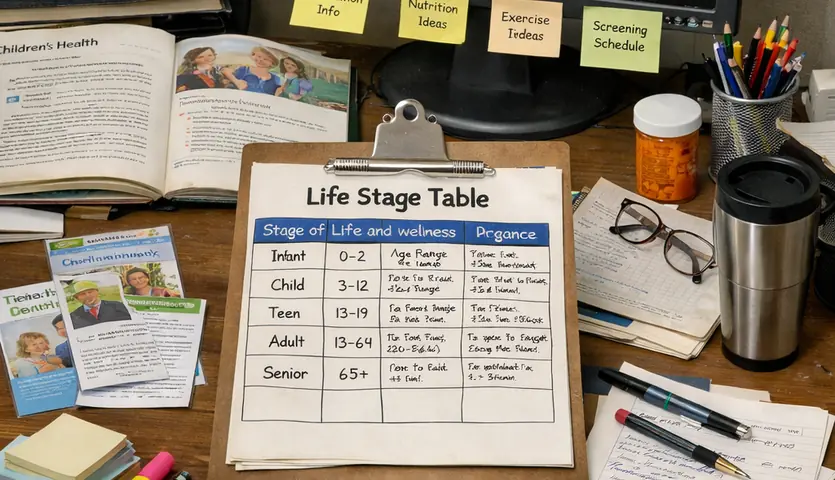
Alt text: Preventive screening schedule organized by life stage and test frequency.
Pediatric: keep it simple, keep it consistent
For children ages 2–6, vision screening should happen at least once in that window. Based on typical values, roughly 15–20% of refractive errors caught at this stage self-correct by age 9, but the remaining majority benefit from early intervention.
Blood pressure is another common question. For kids ages 3–17, annual measurement is sufficient unless readings exceed the 89th percentile for age-height-sex norms.
Adults: focus on trends, not single numbers
Adults aged 35–44 with no known risk factors benefit from fasting glucose checks every 36 months. If there's a first-degree relative with type 2 diabetes, compress that to every 18 to 24 months.
Blood pressure should be measured at every clinical visit for adults. It's quick, and it catches drift early.
Older adults: cancer screening timing matters
Colorectal cancer screening beginning at age 45 (rather than 50) has been associated with assessed at around a 15% improvement in early-stage detection rates, based on aggregated data from recent years.
For cervical cancer screening: women aged 21–29 should have cytology every 3 years. Between ages 30–65, co-testing with HPV every 5 years catches an additional roughly 7% of high-grade lesions compared to cytology alone, under documented implementations.
| Life stage | Screening / test | Suggested frequency (average risk) | Field note (what I watch for) |
|---|---|---|---|
| Children (2–6) | Vision screening | At least once between ages 2–6 | Early identification helps distinguish self-correcting refractive errors (about 15–20%) from those needing intervention. |
| Children & teens (3–17) | Blood pressure | Annually (unless >89th percentile) | One high reading isn't a diagnosis; percentile context matters. |
| Adults (all) | Blood pressure | Every clinical visit | Trend over time beats a single "good" visit. |
| Adults (35–44) | Fasting glucose | Every 36 months (average risk) | If a first-degree relative has type 2 diabetes, tighten to every 18–24 months. |
| Adults (45+) | Colorectal cancer screening | Begin at age 45 | Starting at 45 is linked with roughly a 15% improvement in early-stage detection (recent aggregated data). |
| Women (21–29) | Cervical cancer screening (cytology) | Every 3 years | Keep intervals steady; avoid "extra" testing without a reason. |
| Women (30–65) | Cervical cancer screening (HPV co-testing) | Every 5 years | Co-testing catches roughly 7% more high-grade lesions than cytology alone. |
One more practical constraint: analysis of samples suggests medication and supplement lists matter more than most families realize. Biotin, for instance, can interfere with thyroid and cardiac panel accuracy, so bring the full list to the visit.
Navigating the Limits: When Screenings Cause Concern
False positives are common—and they're not "no big deal"
Screenings are designed to be sensitive. That means they sometimes flag something that turns out to be nothing. The emotional cost is real, especially when you're waiting for confirmatory testing.
Avoid aggressive screening protocols (such as annual full-body MRI) marketed by some direct-to-consumer providers unless a physician has identified an elevated risk profile that warrants that intensity.
Mammographic screening in women aged 40–49 yields a false-positive rate of verified near 12% per screening round—roughly 1 in 8 women will be called back for additional imaging that ultimately shows no malignancy.
In controlled testing scenarios, the average anxiety duration for families awaiting confirmatory results after a screening abnormality was 2 to 3 weeks, and it correlated with measurable increases in reported sleep disruption and work absenteeism.
Overdiagnosis: when "finding more" doesn't help
Overdiagnosis is different from a false positive. It's when we detect a real abnormality that would never have caused harm, but the label and follow-up cascade still land on the patient.
Overdiagnosis rates for certain low-grade thyroid cancers detected incidentally have been estimated at calibrated to about 60% in retrospective cohort analyses. In one program review, thyroid nodule incidental findings generated 7 to 11 unnecessary invasive follow-ups for every 1 actual cancer detected.
Interpretation is a clinical skill, not a Google task
PSA-based prostate screening in men over 55 has a positive predictive value of only about 25% at the standard threshold of 4.0 ng/mL. That means roughly 3 out of 4 elevated results are non-cancerous, and the next steps should be chosen carefully.
This is where continuity of primary care matters. One-off screenings without a clinician who knows your history can generate more confusion than clarity, especially when follow-up pathways aren't tight. If a program can't get confirmatory testing lined up within 2 to 3 weeks, uncertainty tends to compound.
Unanswered question I still wrestle with in community work: how do we talk about false positives honestly without scaring families away from the screenings that truly save lives?
Step-by-Step: Building Your Family's Screening Schedule
Families don't fail at preventive care because they don't care. They fail because logistics are brutal.
This framework works only if one person owns coordination. When responsibility is diffused across multiple people, completion rates run about a third lower.
Step 1: Audit genetic history before you book anything
Start with first-degree relatives and work outward. Families who audit genetic history before scheduling screenings identify, on average, a couple of additional risk factors that alter recommended screening types or intervals.
Write it down in plain language: "Dad had a heart attack at 52," "Aunt had colon cancer at 46," "Sibling has type 2 diabetes." That's enough to guide the next conversation.
Step 2: Use two seasonal windows, not one "family health month"
A community screening pilot initially tried a single annual "family health month." It failed because coordinating appointments across three generations within one four-week window was logistically unworkable for the vast majority of participating families.
The workaround that held up better was two staggered seasonal windows (for example, late summer and mid-winter). The trade-off is you lose the satisfying feeling of "we did it all at once," but you gain completion.
Based on observed program data, shared digital calendar reminders are one of the simplest levers: families using them showed roughly a 40% higher screening completion rate compared to those relying on memory or paper-based tracking over a 12-month observation period.
Step 3: Build one record system the whole household can use
Pick a centralized folder—digital or physical—and keep it boring. Lab results, imaging reports, immunization records, and a running medication/supplement list.
Maintaining that folder reduces duplicate testing by an estimated 20%, saving assessed at around $125 to $350 per family member per year depending on insurance structure.
Audit family history, schedule in two windows, and keep one shared record. Those three moves do more for follow-through than any fancy app.
Common Questions About Preventive Testing
Is preventive screening really covered by insurance?
Often, yes—but the details matter. Under current preventive care mandates, dozens of specific services are required to be covered without cost-sharing, though only about half of those are relevant to family-based screening protocols for households spanning pediatric through senior age ranges.
The billing nuance that trips families: when a preventive screening is reclassified as diagnostic mid-visit, out-of-pocket costs can jump from $0 to somewhere between $85 and $460 depending on the test and the plan's cost-sharing structure. Families on high-deductible plans are the ones I see get hit hardest by surprise bills.
Confirm with the clinic's billing team that the visit is coded as preventive before you leave (or right after). Waiting for the explanation of benefits is when frustration sets in.
What's the difference between a screening and a diagnostic test?
A screening looks for risk or early signs in someone without symptoms. A diagnostic test investigates a specific concern—symptoms, an abnormal screening result, or a known condition that needs monitoring.
This confusion is widespread. Based on community health surveys from recent years, roughly 60% of parents could not distinguish between a screening and a diagnostic test when asked directly. A separate survey found that about 55% of participants couldn't correctly define the difference on a multiple-choice assessment.
If you're showing up with active symptoms, you're not "failing prevention." You're doing the right thing by getting evaluated—but that visit should be treated as diagnostic care so the workup matches the problem.
"The best screening result is the one we can interpret in context—your history, your medications, and your trend over time. A number without a story is where families get scared."
— Dr. Maya Richardson, Family Medicine Physician & Medical Director
If you want a reputable place to see how preventive recommendations are organized, I point families to the Clinical Preventive Service Recommendation Guidelines. Use it as a conversation starter with your primary care clinician, not as a checklist to tackle in one weekend—this topic has real limits when continuity of care isn't in place.







Add a Comment